Camel Milk
RegionalNorth and East Africa, the Middle East, and parts of South and Central Asia
Milk from camels, an important traditional dairy source in many arid and semi-arid regions. It is consumed fresh as well as in fermented forms.
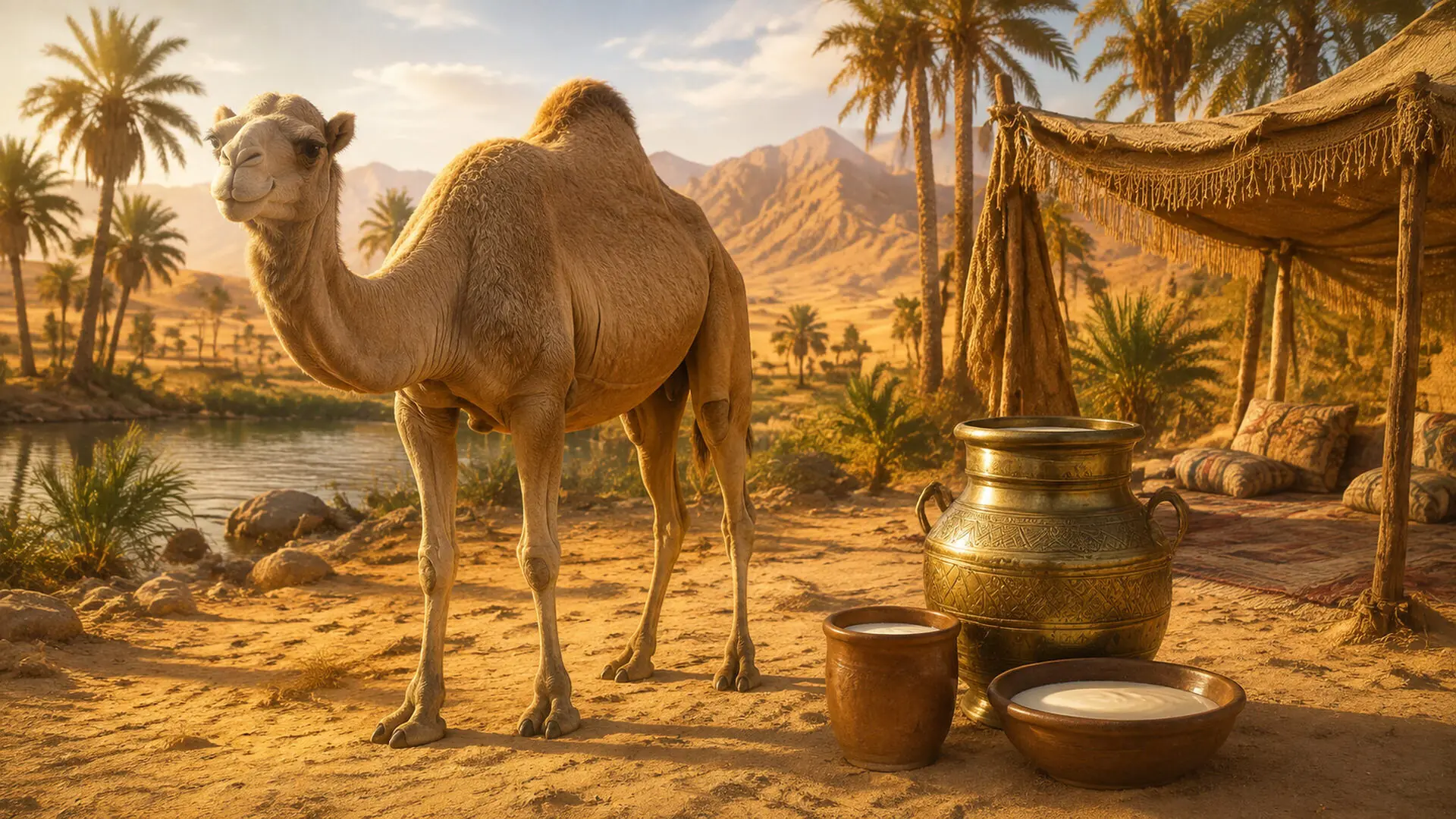


Milk from camels, an important traditional dairy source in many arid and semi-arid regions. It is consumed fresh as well as in fermented forms.
Camel milk is produced by the dromedary camel (Camelus dromedarius, the one-humped species) and to a lesser extent the Bactrian camel (Camelus bactrianus, the two-humped species). It has been consumed by nomadic and pastoral communities across North Africa, the Middle East, and Central Asia for thousands of years, serving as a critical source of nutrition in arid and semi-arid regions where other dairy animals cannot thrive. According to the Food and Agriculture Organization of the United Nations (FAO), camel milk production is estimated at over 5 million tonnes annually worldwide, with the majority produced in Somalia, Kenya, Ethiopia, Mali, and other parts of East Africa and the Sahel.
Camel milk differs from cow milk in several notable ways. It contains no beta-lactoglobulin — the whey protein most commonly associated with cow milk allergy — which means some people who are allergic to cow milk can tolerate camel milk. It is also lower in fat than cow milk, with fat globules that are smaller in size and more evenly distributed, giving it a naturally homogenised appearance. Camel milk does not curdle easily with acid and is difficult to make into traditional rennet-based cheese, though fermented camel milk products such as shubat (a fizzy fermented camel milk drink popular in Central Asia) are produced regionally.
In recent years, camel milk has attracted significant commercial interest in Europe, North America, and Australia, marketed for its distinctive composition and the traditional knowledge associated with its consumption in pastoral communities. It is sold fresh, pasteurised, and as a powdered product. Prices are considerably higher than cow milk due to the lower yields of camels (typically 3–10 litres per day) and the difficulty of milking them.
Camel milk composition varies by breed, feed, and season. Typical values for dromedary camel milk (per 240 ml):
Camel milk is notably higher in vitamin C and iron than cow milk. It contains lactoferrin and immunoglobulins at higher concentrations than cow milk. It does not contain beta-lactoglobulin, and some research suggests its casein structure differs from cow milk, which may explain why some cow milk-allergic individuals tolerate it. It still contains lactose and is not suitable for people with lactose intolerance.
Camel milk is consumed fresh across North Africa, the Middle East, and Central Asia, where it forms an important part of the diet of pastoral communities. Shubat, a naturally carbonated fermented camel milk drink, is popular in Kazakhstan and surrounding Central Asian countries. In the Gulf states and East Africa, fresh camel milk is sold commercially in urban markets. Internationally, camel milk is sold pasteurised or as a freeze-dried powder. Camel milk chocolate has emerged as a premium product, produced notably in Dubai and Belgium.