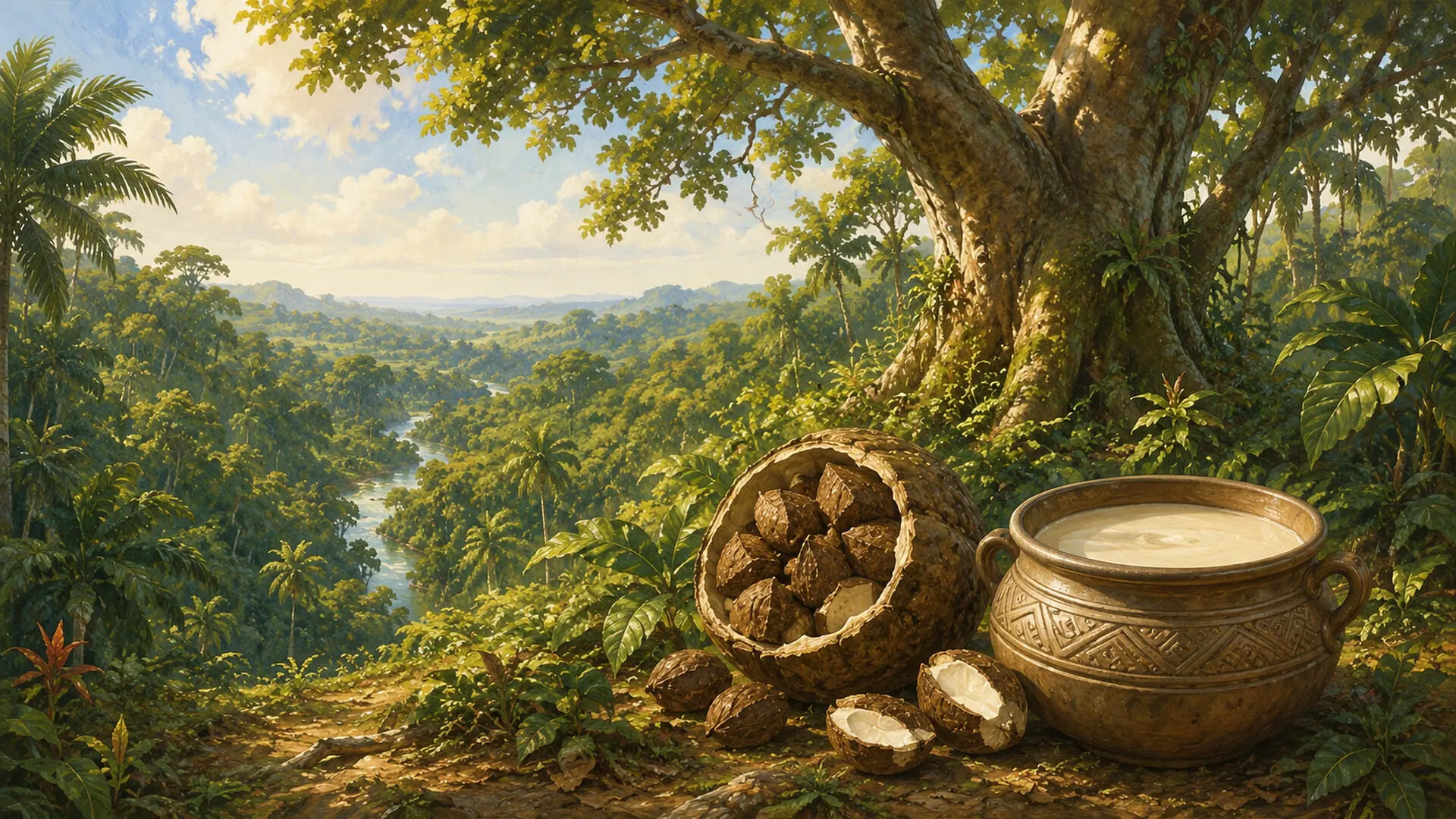
Limited production; Brazil nuts originate in the Amazon region of South America
A plant-based beverage produced by grinding and extracting Brazil nuts with water. Research formulations demonstrate that processing method and nut-to-water ratio substantially affect the resulting beverage.
About Brazil Nut Milk
Brazil nut milk is a plant-based beverage made from the seeds of the Brazil nut tree (Bertholletia excelsa), a large Amazonian tree native to South America. Brazil nuts are harvested almost exclusively from wild trees in the Amazon rainforest, primarily in Bolivia, Brazil, and Peru. The trees cannot be successfully cultivated in plantations and rely on a specific Amazonian orchid bee for pollination, making Brazil nuts one of the few major food crops that must be wild-harvested at scale.
Brazil nut milk is made by soaking Brazil nuts in water, blending them with fresh water, and straining the resulting liquid through a nut milk bag or fine cloth. The resulting milk is creamy and rich, with a mildly nutty, slightly earthy flavour. Brazil nuts have an exceptionally high fat content — approximately 66% fat by weight — producing a milk that is noticeably creamier and more calorie-dense than almond or oat milk.
Brazil nuts are notably selenium-rich. A finished Brazil-nut drink can contain much less per serving than the whole nuts, depending on recipe and straining. However, selenium content varies considerably depending on the soil where the trees grow, and excessive selenium consumption can be harmful. Brazil nut milk retains some but not all of the selenium from the whole nut depending on the preparation method.
Brazil nut milk nutritional content varies by preparation. Brazil nuts themselves are very high in fat and selenium:
FatHigh (mostly unsaturated)
ProteinModerate
SeleniumVery high in whole nuts
CalciumLow unless fortified
LactoseNone
GlutenNone
Brazil nut milk is one of the creamier plant milks due to the high fat content of the nuts. It is dairy-free, lactose-free, and gluten-free. The selenium content in the milk depends on how many nuts are used and their origin. Nutritionists advise against eating very large quantities of Brazil nuts due to the risk of selenium toxicity.
Brazil nut milk can be used like other nut milks — in smoothies, coffee, tea, baking, and desserts. Its creamy texture makes it particularly suitable for rich desserts and creamy sauces. The mild, slightly earthy flavour pairs well with chocolate and vanilla. It is primarily a homemade product as commercial production is limited by the wild-harvest supply chain of Brazil nuts.
Interesting Facts
Brazil nut trees can live for 500–1,000 years and grow up to 50 metres tall — they are among the largest trees in the Amazon rainforest.
Brazil nuts must be pollinated by large-bodied orchid bees (Eulaema and related species) that are large enough to open the flowers — smaller bees cannot do the job, meaning Brazil nut trees cannot be commercially cultivated away from their natural ecosystem.
Just one or two Brazil nuts can provide a full day's recommended intake of selenium for an adult — making them one of the most selenium-dense foods in the world.
Bolivia is the world's largest exporter of Brazil nuts, surpassing Brazil itself in recent decades.
The Brazil nut tree (Bertholletia excelsa) produces a large, hard seed pod like a coconut, inside which 10–25 individual Brazil nuts are packed like orange segments.