Powdered Milk
CommonWorldwide
A shelf-stable dairy product produced by removing most of the water from milk. Different forms include whole, partly skimmed, and skimmed milk powders.
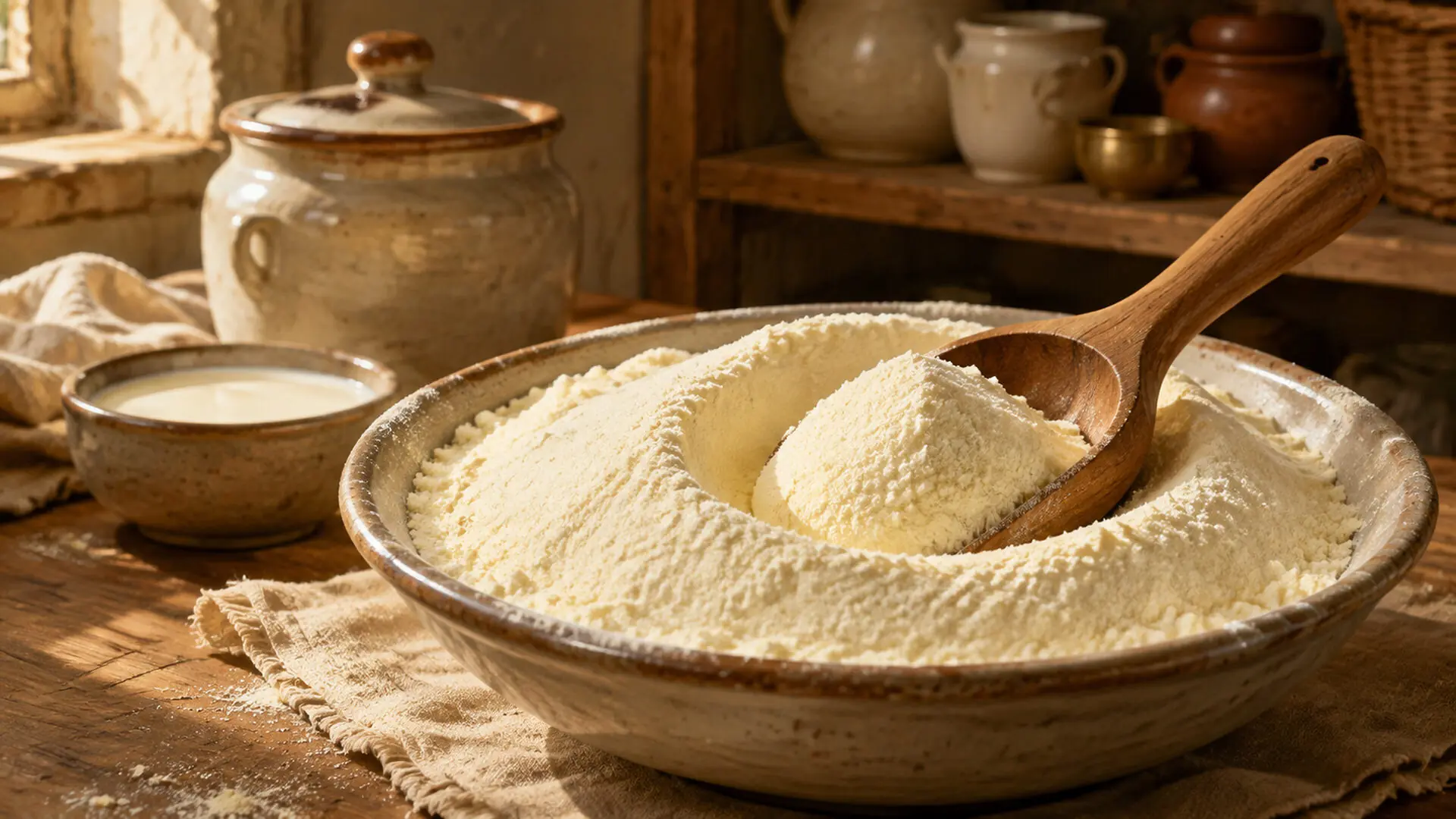
A shelf-stable dairy product produced by removing most of the water from milk. Different forms include whole, partly skimmed, and skimmed milk powders.
Powdered milk (also known as dried milk or milk powder) is a shelf-stable dairy product produced by evaporating liquid milk to dryness, leaving a free-flowing powder that can be reconstituted by adding water. It is produced by spray-drying — a process in which concentrated liquid milk is atomised into a very fine mist and sprayed into a chamber of hot, dry air, causing the water to evaporate almost instantly and leaving behind tiny, dry milk particles. The resulting powder can be stored at room temperature for months to years, making it a critical product for food security, humanitarian aid, and markets where refrigeration is limited.
Powdered milk is produced in full-fat (whole milk powder), skimmed (non-fat dry milk), and partially skimmed varieties. Skimmed milk powder (SMP) is the most widely traded form internationally, as fat-free powder has better storage stability (milk fat can oxidise and become rancid over time). Whole milk powder (WMP) is produced where fat content is desirable — it is widely used in chocolate manufacturing and confectionery. The Codex Alimentarius standards for milk powders (CXS 207-1999) specify minimum and maximum fat and moisture content for various powder categories.
Powdered milk plays an enormous role in global food systems. It is used as an ingredient in chocolate, infant formula, bakery products, confectionery, ready-to-drink beverages, and processed foods. It is the primary dairy product traded internationally and forms the basis of dairy market pricing globally. Major exporters include New Zealand, the European Union, Australia, and the United States.
Whole milk powder (per 32g / approximately 4 tablespoons, equivalent to 240ml reconstituted):
When reconstituted, whole milk powder has a nutritional profile close to fresh whole milk. Skimmed milk powder is virtually fat-free and provides more protein and calcium per calorie. Powdered milk retains most of the vitamins and minerals of fresh milk, though some heat-sensitive vitamins are reduced during the spray-drying process.
Powdered milk is used extensively in food manufacturing — it is a key ingredient in milk chocolate (providing the dairy solids), most infant formulas, baked goods, instant soups, and processed foods. Reconstituted with water, it serves as a direct substitute for fresh milk in cooking and drinking. It is widely used in humanitarian food aid programmes, military rations, and remote and outdoor settings where fresh dairy is unavailable. In many parts of South Asia and the Middle East, powdered milk is a household staple used to prepare beverages and desserts.